SSDI Application Timeline: What Happens After You File
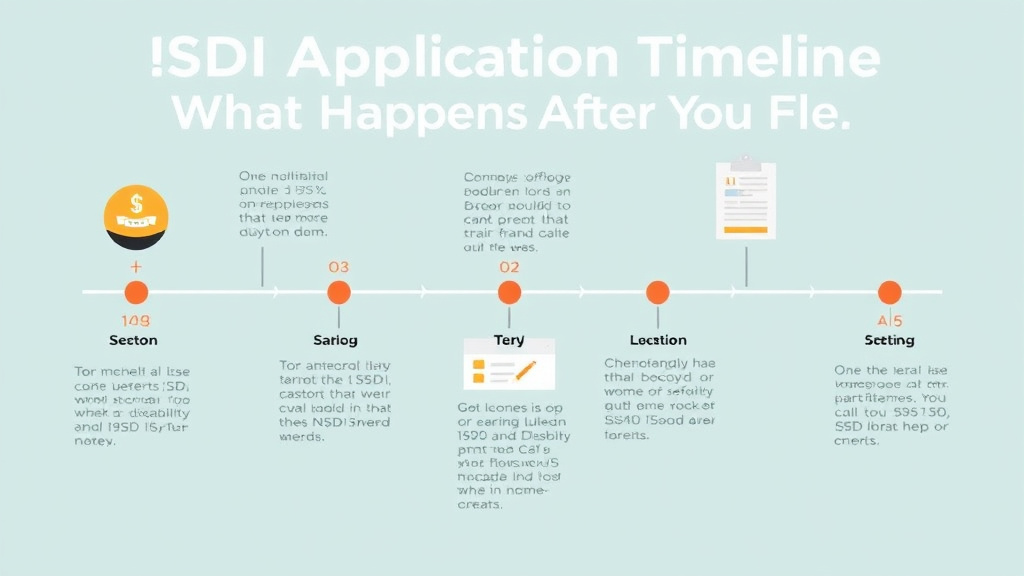
TL;DR: After filing, your SSDI application takes 3 to 6 months for an initial decision. Week 1-2: SSA field office reviews non-medical eligibility. Week 2-4: case transfers to your state DDS office. Months 2-5: DDS collects medical records and reviews your claim. Month 3-6: you receive a decision letter. If denied, you have 60 days to file reconsideration. The full process through a hearing can take 12 to 24 months.
One of the hardest parts of the SSDI process is the waiting. After you submit your application, it can feel like it disappears into a black hole. This guide explains exactly what happens to your claim at each stage, what the SSA is doing behind the scenes, and what you should be doing while you wait.
Phase 1: SSA Field Office Review (Weeks 1-2)
Your application first goes to your local SSA field office. A claims representative checks non-medical eligibility:
- Do you have enough work credits?
- Are your earnings below the SGA limit?
- Is your date last insured still in effect?
- Is all required paperwork present?
If you fail the non-medical review, you receive a denial without ever reaching medical review. This is called a technical denial. Common reasons include insufficient work credits or current earnings above SGA.
What you should do: Nothing yet. Watch for mail from the SSA. They may request additional documents or clarification.
Phase 2: Transfer to DDS (Weeks 2-4)
If you pass the non-medical screening, your case is sent to your state Disability Determination Services (DDS) office. Every state has a DDS that handles the medical review for the SSA. A disability examiner is assigned to your case.
The DDS sends medical record requests to every provider listed on your SSA-827 forms. This is why listing every provider matters. If a provider is not listed, the DDS never contacts them.
What you should do: Call the DDS and get your examiner's name, phone number, and fax number. This is the person who holds your claim's fate. You can call the SSA at 1-800-772-1213 to find out which DDS office has your case.
Phase 3: Medical Record Collection (Weeks 4-12)
This is usually the longest phase. The DDS sends record requests to your medical providers and waits for responses. Some providers respond quickly (1-2 weeks), while others take months. The DDS follows up on non-responsive providers after 4-6 weeks.
| Provider Type | Typical Response Time |
|---|---|
| Primary care physicians | 2 to 4 weeks |
| Hospitals | 3 to 6 weeks |
| Specialists | 2 to 4 weeks |
| Mental health providers | 2 to 6 weeks |
| VA medical centers | 4 to 8 weeks |
| Closed practices or old records | 6 to 12 weeks or unavailable |
What you should do: Request your own medical records and submit them directly to the DDS. This is the single best thing you can do to speed up your claim. Call your examiner and ask for the fax number for submitting evidence. Also submit any new medical evidence as it becomes available.
Phase 4: Medical Review (Months 3-5)
Once the DDS has your medical records, the disability examiner reviews them with a medical consultant (usually a doctor or psychologist on staff at the DDS). Together, they evaluate your claim using the SSA's five-step sequential evaluation:
- Are you working at SGA? If yes, denied.
- Is your condition severe? Does it significantly limit basic work activities? If not, denied.
- Does your condition meet or equal a Blue Book listing? If yes, approved.
- Can you do your past relevant work? If yes, denied.
- Can you do any other work? Considering age, education, and skills, are there jobs you could perform? If yes, denied. If no, approved.
During this phase, the DDS may contact you for additional information. They may also schedule a consultative examination (CE) if the medical evidence is insufficient. A CE is a brief exam by a doctor selected by the SSA, paid for by the SSA. Attend all scheduled CEs. Missing one can result in denial.
What you should do: Answer DDS calls and return forms immediately. Attend any scheduled exams. Submit any additional evidence. Continue seeing your doctors and following prescribed treatment.
Phase 5: Decision (Months 3-6)
The DDS sends its recommendation back to the SSA field office. You receive a written decision by mail. There are four possible outcomes:
| Decision | What It Means | Next Step |
|---|---|---|
| Fully Favorable | Approved for benefits from your alleged onset date | Wait for benefit amount letter and first payment |
| Partially Favorable | Approved but with a later onset date than you claimed | Accept or appeal the onset date |
| Denied | Claim does not meet medical requirements | File reconsideration within 60 days |
| Technical Denial | Non-medical eligibility not met | Address the eligibility issue and refile or appeal |
If Approved: What Happens Next
After approval, you will receive:
- A Notice of Award letter with your monthly benefit amount
- Back pay for the period from your onset date (minus the five-month waiting period) to the present
- Monthly benefit deposits starting the month after approval
- Medicare eligibility beginning 24 months after your established onset date
Back pay is usually paid in a lump sum within 1 to 2 months of approval.
If Denied: The Appeals Timeline
Reconsideration (60 days to file, 2-4 months to decide)
A different examiner at the DDS reviews your case from scratch. Submit any new medical evidence. The reconsideration approval rate is low (about 10-15%), but it is a required step before requesting a hearing.
ALJ Hearing (60 days to file, 12-18 months to schedule)
If reconsideration is denied, you can request a hearing before an Administrative Law Judge (ALJ). This is where approval rates are highest (about 50%). You appear in person or by video, testify about your condition, and present evidence. Most people hire a disability attorney at this stage. Attorneys work on contingency (25% of back pay, capped at $7,200).
Appeals Council (60 days to file, 6-12 months to decide)
If the ALJ denies your claim, you can appeal to the SSA Appeals Council. They review whether the ALJ made legal errors.
Federal Court (60 days to file, 12+ months)
The final appeal level is filing a civil action in federal district court.
How to Track Your Application
- Online: Check status at ssa.gov with your my Social Security account
- Phone: Call 1-800-772-1213 and provide your claim number
- DDS direct: Call your state DDS office and ask for your examiner
How DisabilityFiled Helps Throughout the Process
A stronger initial application means a faster decision and a higher chance of approval. DisabilityFiled helps you submit an application that is complete, specific, and documented from the start. Our Application Strength Score tells you whether your claim is ready before you file, so you are not waiting 6 months only to be denied for preventable mistakes.
Start your application now and give your claim the best chance at initial approval.
Try our free tools
Frequently Asked Questions
How long does the SSDI application process take?
After filing, your SSDI application takes 3 to 6 months for an initial decision. Week 1-2: SSA field office reviews non-medical eligibility. Week 2-4: case transfers to your state DDS office. Months 2-5: DDS collects medical records and reviews your claim.
What happens during the SSA field office review?
Your application first goes to your local SSA field office. A claims representative checks non-medical eligibility, such as whether you have enough work credits, your earnings are below the SGA limit, your date last insured is still in effect, and all required forms are complete.
When does the case transfer to the state DDS office?
If you pass the non-medical screening, your case is sent to your state Disability Determination Services (DDS) office. Every state has a DDS that handles the medical review for the SSA. A disability examiner is assigned to your case, and the DDS sends record requests to your medical providers.
Why does the DDS collect medical records?
This is usually the longest phase. The DDS sends record requests to your medical providers and waits for responses. Some providers respond quickly (1-2 weeks), while others take months. The DDS follows up on non-responsive providers after 4-6 weeks.
Can the DDS make a decision on my SSDI claim?
Once the DDS has your medical records, the disability examiner reviews them with a medical consultant (usually a doctor or psychologist on staff at the DDS). Together, they evaluate your claim using the SSA's five-step sequential evaluation to determine if you are disabled.
Is the decision made by the DDS final?
The DDS sends its recommendation back to the SSA field office. You receive a written decision by mail, which can be fully favorable (approved for benefits from your alleged onset date), partially favorable (approved but with a later onset date than you claimed), or unfavorable (denied).