Getting SSDI for Back Pain: The Short Answer
TL;DR: The SSA approves SSDI for chronic back pain when you can prove structural abnormalities through imaging and show that your pain limits your ability to sit, stand, walk, or lift enough to hold any job. Back pain falls under SSA Listing 1.15 (Disorders of the skeletal spine) or 1.16 (Lumbar spinal stenosis). You need MRI or CT evidence, at least 12 months of treatment records, and documented functional limitations. Most denials happen because applicants describe pain levels instead of functional limits.DisabilityFiled offers a $49 Complete Packet that organizes your information for your own application. It is a document preparation service, not a law firm, and it does not provide legal advice or guarantee any outcome.

SSA Blue Book Listing for Back Pain
Back pain claims are evaluated under Section 1.15 (Disorders of the skeletal spine resulting in compromise of a nerve root) and Section 1.16 (Lumbar spinal stenosis resulting in compromise of the cauda equina). These listings replaced the old Listing 1.04 in April 2021.
To meet Listing 1.15, you need all of the following:
- Neuro-anatomic (radicular) distribution of pain
- Limitation of movement of the spine
- Motor loss (muscle weakness, atrophy, or sensory/reflex changes)
- A medically determinable impairment shown by imaging (MRI, CT, or X-ray)
- Inability to use one or both upper extremities to independently initiate, sustain, and complete work activities, OR inability to use one or both lower extremities to independently ambulate
To meet Listing 1.16 (lumbar spinal stenosis), you need:
- Symptoms of bilateral neurological compromise shown by imaging
- Inability to ambulate effectively, defined as needing a walker, two crutches, or two canes
What Medical Evidence the SSA Needs
The SSA does not approve claims based on pain alone. You need objective evidence. Here is what matters most.
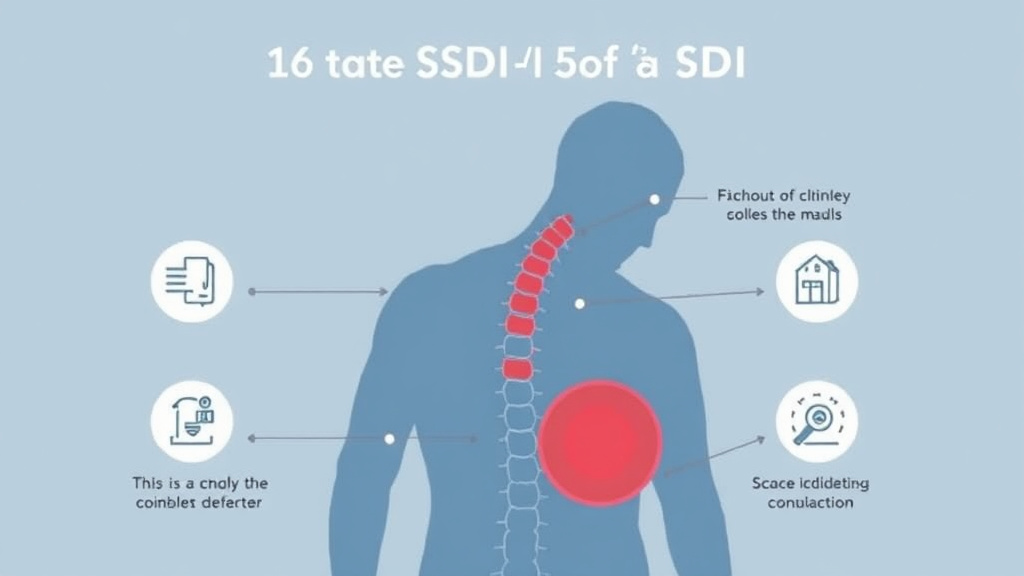
Imaging Studies
| Type | What It Shows | SSA Weight |
|---|---|---|
| MRI | Disc herniations, nerve compression, spinal cord issues | Highest |
| CT Scan | Bone spurs, fractures, structural issues | High |
| X-ray | Alignment, disc space narrowing, degenerative changes | Moderate |
| EMG/NCV | Nerve damage, radiculopathy confirmation | High for nerve claims |
Treatment Records
The SSA wants to see at least 12 months of consistent treatment. This includes:
- Regular doctor or specialist visits (every 4-8 weeks minimum)
- Pain management records
- Physical therapy notes showing limited improvement
- Medication history, including side effects
- Injection records (epidurals, nerve blocks, facet injections)
- Surgical records if applicable
Physician Statements
A residual functional capacity (RFC) statement from your treating physician is one of the most valuable pieces of evidence. This form should detail exactly what you can and cannot do physically, including how long you can sit, stand, walk, and how much you can lift.
How to Describe Your Limitations in SSA Language
This is where most claims fail. The SSA does not care that your pain is a "10 out of 10." They care about functional limitations, meaning what you cannot do because of your back pain.
Wrong Way vs. Right Way
| What You Say | What the SSA Needs to Hear |
|---|---|
| "My back hurts all the time" | "I cannot sit for more than 20 minutes without needing to change positions due to lumbar radiculopathy" |
| "I can't do anything" | "I am unable to lift more than 5 pounds, cannot bend at the waist, and must lie down for 2-3 hours during the day due to pain and muscle spasms" |
| "The pain is unbearable" | "My pain medication causes drowsiness and cognitive slowing that would prevent me from maintaining concentration for 2-hour intervals required for competitive employment" |
| "I had surgery and it didn't help" | "Post-surgical imaging shows failed back surgery syndrome with continued nerve root compression at L4-L5 and L5-S1" |
DisabilityFiled's SSA Language Translator converts your everyday descriptions of pain and limitations into the functional language that SSA adjudicators are trained to evaluate. This is the same terminology disability attorneys use, but without the 25% fee.
Common Denial Reasons for Back Pain Claims
Back pain is one of the most commonly claimed conditions, and one of the most commonly denied. Here is why claims get rejected:
- Insufficient imaging evidence. An X-ray showing "mild degenerative changes" will not get you approved. You need an MRI showing specific structural problems like herniations, stenosis, or nerve compression.
- Gaps in treatment. If you went to the doctor once, then did not return for six months, the SSA assumes you improved. Consistent treatment records are essential.
- Pain-only descriptions. Saying "it hurts" is not enough. You must describe what you cannot do and for how long.
- No RFC from your doctor. Without a physician-completed RFC form, the SSA uses its own doctors to assess you, and those doctors typically rate you as more capable than you are.
- Age-related bias. If you are under 50, the SSA applies stricter rules and may assume you can be retrained for sedentary work. You need to prove you cannot even do desk work.
- Failure to follow prescribed treatment. If your doctor recommended physical therapy or surgery and you did not follow through, the SSA may deny based on non-compliance.
Compassionate Allowance Status
Standard back pain conditions are not on the SSA's Compassionate Allowance list. There is no fast-track approval. Your claim will go through the standard 3-6 month evaluation process at the initial level. However, some related conditions like certain spinal cord disorders or cancers affecting the spine may qualify for expedited processing.
Tips for the Function Report (Form SSA-3373)
The Function Report is where many back pain claims are won or lost. The SSA uses this form to understand how your condition affects daily life.
Daily Activities Section
- Describe your worst days, not your best. The SSA wants to know your baseline, not what you can do on a good day with medication.
- Be specific about time limits. "I can stand for 10 minutes before I need to sit down" is better than "I have trouble standing."
- Mention rest periods. "I need to lie down for 2 hours in the afternoon because my back seizes up" directly addresses the SSA's concern about work attendance.
Physical Abilities
- Sitting: State your maximum sitting time before you need to shift, stand, or lie down. If it is under 30 minutes, say so.
- Standing: Note how long you can stand in one position. Include whether you need to lean on something.
- Walking: State your maximum walking distance. Use blocks or minutes, not vague terms.
- Lifting: Give a specific weight limit. "I cannot lift a gallon of milk with one hand" is concrete and relatable.
- Bending: Note if you cannot bend to tie shoes, pick things up off the floor, or turn to look behind you.
Medication Effects
- List every medication and its side effects. Drowsiness, brain fog, nausea, and constipation from pain medications directly affect your ability to work.
- If you have tried and failed multiple medications, list them all. This shows the SSA your condition is treatment-resistant.
How DisabilityFiled Helps With Back Pain Claims
Back pain is the single most common condition in SSDI applications, but it also has one of the highest denial rates. The reason is not that back pain does not qualify. It is that applicants fail to present their evidence in the way the SSA evaluates it.
DisabilityFiled's AI-powered system does three things that dramatically improve your chances:
- AI Intake Conversation: Asks you targeted questions about your back condition, then organizes your answers into SSA-compliant categories.
- SSA Language Translator: Converts your plain-language descriptions into the medical-legal terminology that SSA adjudicators use to make decisions.
- Application Strength Score: Analyzes your application before you submit it and identifies weak spots so you can fix them first.
DisabilityFiled offers a $49 Complete Packet that organizes your information for your own application. It is a document preparation service, not a law firm, and it does not provide legal advice or guarantee any outcome. No percentage of your backpay. No attorney taking 25% of what you are owed. You keep 100% of your benefits.
Related Condition Guides
- SSDI for Degenerative Disc Disease
- SSDI for Herniated Disc
- SSDI for Spinal Stenosis
- SSDI for Spinal Fusion
- SSDI for Neck Pain
The Real Cost of SSDI Help: Attorney vs. DisabilityFiled
Most SSDI applicants face a choice: go it alone, hire a disability attorney, or use a service like DisabilityFiled. Here is a straightforward comparison:
| Option | Cost | What You Get | What You Keep |
|---|---|---|---|
| Go it alone | Free | Government forms and instructions only | 100% of benefits (if approved, which happens 38% of the time) |
| Disability attorney | 25% of backpay (up to $7,200) | Legal representation, hearing preparation | 75% of backpay |
| Allsup/similar services | 25-33% of backpay | Claim management, form completion | 67-75% of backpay |
| DisabilityFiled | $49 one-time | AI-powered application with SSA language translation, strength scoring, form auto-population | 100% of benefits and backpay |
Consider the math: if you receive $1,800 per month in SSDI and are approved with 12 months of backpay, that is $21,600. An attorney takes up to $5,400 of that.DisabilityFiled offers a $49 Complete Packet that organizes your information for your own application. It is a document preparation service, not a law firm, and it does not provide legal advice or guarantee any outcome. The difference is $5,321 that stays in your pocket.
What to Expect During the SSDI Process
Understanding the process helps you prepare at each stage:
Stage 1: Initial Application (3-6 months)
You submit your application, medical records are gathered, and a disability examiner reviews your case. About 38% of claims are approved at this stage. DisabilityFiled helps you build the strongest possible initial application to maximize your chances here.
Stage 2: Reconsideration (3-5 months)
If denied, you request reconsideration. A different examiner reviews your case with any new evidence. About 13% of reconsiderations are approved.
Stage 3: ALJ Hearing (12-18 months)
If denied again, you request a hearing before an Administrative Law Judge. This is where most cases are won, with about 50% approval rate. You can testify in person about your limitations.
Stage 4: Appeals Council (6-12 months)
If the ALJ denies you, you can request Appeals Council review. The council reviews for legal errors, not new evidence.
Total process can take 2-3 years if you go to hearing. Building a strong initial application with DisabilityFiled gives you the best chance of approval at Stage 1, saving you years of waiting.
Try our free tools
Frequently Asked Questions
How do I get SSDI for back pain?
The Social Security Administration (SSA) approves SSDI for chronic back pain when you can prove structural abnormalities through imaging and show that your pain limits your ability to sit, stand, walk, or lift enough to hold any job.
What listings in the SSA Blue Book cover back pain?
Back pain claims are evaluated under Section 1.15 (Disorders of the skeletal spine resulting in compromise of a nerve root) and Section 1.16 (Lumbar spinal stenosis resulting in compromise of the cauda equina). These listings replaced the old Listing.
What Medical Evidence the SSA Needs?
Back pain is one of the most commonly claimed conditions, and one of the most commonly denied. Claims get rejected due to insufficient imaging evidence, gaps in treatment, and lack of functional limitations. An X-ray showing 'mild degenerative changes' is not enough - you need an MRI showing specific structural problems like herniations, stenosis, or nerve compression. If you went to the doctor once and then did not follow up, the SSA may deny your claim.
How to Describe Your Limitations in SSA Language?
This is where most claims fail. The SSA does not care that your pain is a "10 out of 10." They care about functional limitations, meaning what you cannot do because of your back pain.
Why are back pain claims commonly denied?
Back pain is one of the most commonly claimed conditions, and one of the most commonly denied. Claims get rejected due to insufficient imaging evidence, gaps in treatment, and lack of functional limitations. An X-ray showing 'mild degenerative change' is often not enough.
Can I get a Compassionate Allowance for back pain?
Standard back pain conditions are not on the SSA's Compassionate Allowance list. There is no fast-track approval. Your claim will go through the standard 3-6 month evaluation process at the initial level.
How should I fill out the Function Report (Form SSA-3373) for back pain?
The Function Report is where many back pain claims are won or lost. Describe your worst days, not your best, and be specific about time limits. Explain how your pain and limitations affect your daily activities.