The SSA's 5-Step Evaluation Process Explained
TL;DR: Every SSDI and SSI claim is evaluated through the same five steps in order: (1) Are you working above SGA? (2) Is your condition severe? (3) Does it meet a Blue Book listing? (4) Can you do your past work? (5) Can you do any other work? If you're denied at any step, the process stops. Most denials happen at Steps 4 and 5. Understanding this process tells you exactly what evidence you need and where your case will be decided.
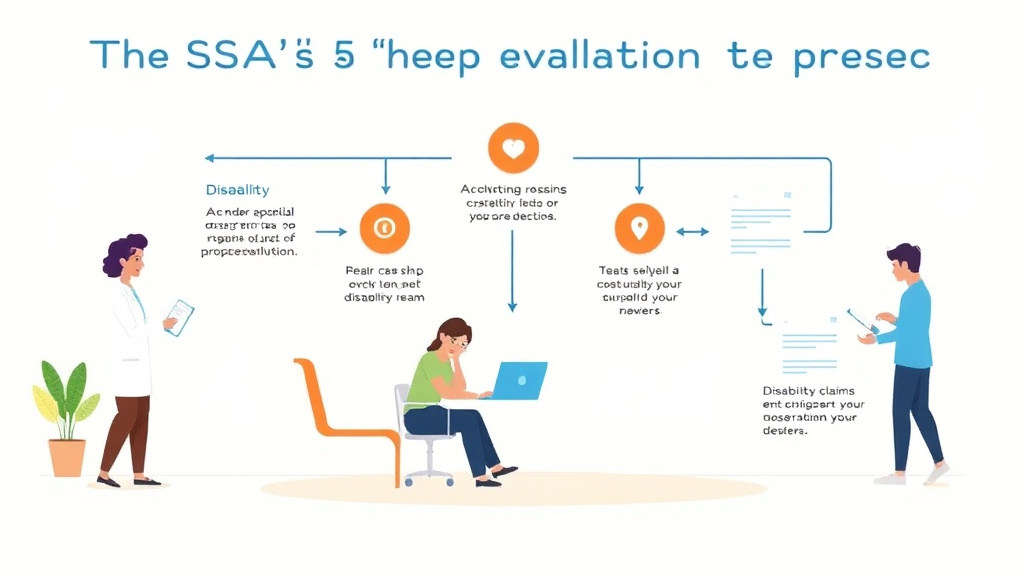
The SSA's sequential evaluation process is not a guideline. It's a rigid, step-by-step framework that every examiner must follow in exact order. Knowing the process lets you predict where your case will be decided and build your evidence accordingly.
The SSDI application process takes an average of 3 to 6 months for an initial decision. If denied, the appeals process can add another 12 to 24 months depending on your region. Having complete and detailed medical documentation is the single biggest factor in SSDI approval. Request records from all treating providers before submitting your application. Many claimants benefit from organizing their medical history into a timeline showing how their condition has progressed. This helps SSA reviewers see the full picture without searching through hundreds of pages.
Step 1: Substantial Gainful Activity
Question: Are you currently working and earning more than $1,620/month (2026)?
If yes, your claim is denied. The SSA doesn't look at your medical evidence. Some exceptions exist for unsuccessful work attempts, subsidized employment, and certain self-employment situations, but this is essentially a bright-line rule.
Evidence needed: Earnings records, employer statements if applicable.
The SSDI application process takes an average of 3 to 6 months for an initial decision. If denied, the appeals process can add another 12 to 24 months depending on your region. Having complete and detailed medical documentation is the single biggest factor in SSDI approval. Request records from all treating providers before submitting your application. Many claimants benefit from organizing their medical history into a timeline showing how their condition has progressed. This helps SSA reviewers see the full picture without searching through hundreds of pages.
Step 2: Severity
Question: Does your condition cause more than a minimal limitation on your ability to perform basic work activities?
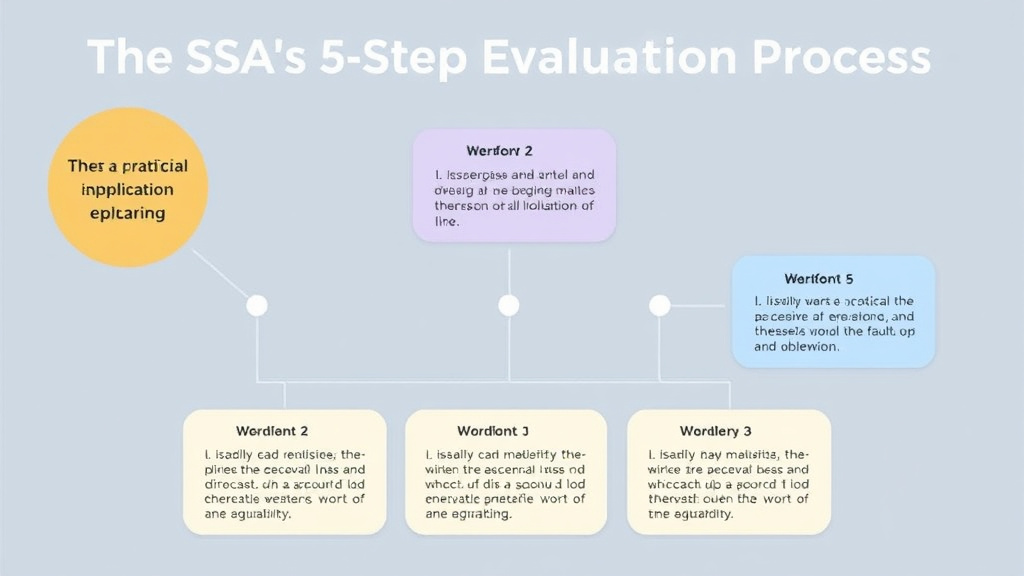
This is a low threshold. Basic work activities include walking, standing, sitting, lifting, carrying, seeing, hearing, speaking, understanding, remembering, concentrating, and interacting with others. If your condition causes any more-than-minimal limitation in any of these, you pass Step 2.
Denials at Step 2 are uncommon for legitimate conditions but do happen for mild, well-controlled conditions.
Evidence needed: Medical records showing a diagnosed condition with documented impact on functioning.
The SSDI application process takes an average of 3 to 6 months for an initial decision. If denied, the appeals process can add another 12 to 24 months depending on your region. Having complete and detailed medical documentation is the single biggest factor in SSDI approval. Request records from all treating providers before submitting your application. Many claimants benefit from organizing their medical history into a timeline showing how their condition has progressed. This helps SSA reviewers see the full picture without searching through hundreds of pages.
Step 3: Listings
Question: Does your condition meet or equal a Blue Book listing?
If your condition meets every criterion of a specific listing, you're approved. If your condition is medically equivalent in severity to a listing (even if you don't meet every exact criterion), you can also be approved at this step.
Many claims don't get approved here because the listing criteria are very specific. But if you have a clear-cut severe condition, this is where your case ends.
Evidence needed: All diagnostic tests, clinical findings, and imaging results that the specific listing requires.
The SSDI application process takes an average of 3 to 6 months for an initial decision. If denied, the appeals process can add another 12 to 24 months depending on your region. Having complete and detailed medical documentation is the single biggest factor in SSDI approval. Request records from all treating providers before submitting your application.
Step 4: Past Relevant Work
Question: Given your RFC, can you perform any of your past jobs?
The SSA determines your Residual Functional Capacity (what you can still do despite limitations) and compares it to the demands of jobs you held in the past 15 years at SGA level for a meaningful period.
Past work is evaluated as "generally performed," meaning the SSA compares your RFC to the job as it's typically done in the national economy, not necessarily exactly how you did it.
If your RFC allows you to do any past job, you're denied.
Evidence needed: Detailed work history (SSA-3369), RFC assessment from your doctor, medical records supporting functional limitations.
Step 5: Other Work
Question: Given your RFC, age, education, and work experience, are there other jobs in the national economy you could perform?
This is where the grid rules apply. The SSA combines your RFC level with your age category, education level, and skill transferability to determine whether other work exists for you.
At the hearing level, a vocational expert (VE) testifies about what jobs are available given your specific limitations. Your representative can cross-examine the VE and present hypothetical scenarios that eliminate more jobs.
Evidence needed: Everything from Steps 1-4 plus clear documentation of your age, education, and work experience. Non-exertional limitations (mental health, pain, fatigue, absences) are critical here because they erode the job base.
Where Most Cases Are Decided
| Step | Outcome | Frequency |
|---|---|---|
| Step 1 | Denied (earning above SGA) | Small percentage |
| Step 2 | Denied (condition not severe) | Small percentage |
| Step 3 | Approved (meets listing) | About 20-25% of approvals |
| Step 4 | Denied (can do past work) | Common denial point |
| Step 5 | Approved or denied | Where most claims are decided |
DisabilityFiled's AI builds your documentation to address each step of the evaluation, ensuring your evidence covers SGA, severity, listing criteria, and RFC.DisabilityFiled offers a $49 Complete Packet that organizes your information for your own application. It is a document preparation service, not a law firm, and it does not provide legal advice or guarantee any outcome.
Start your application with DisabilityFiled
Related Articles
Try our free tools
Frequently Asked Questions
How does the SSA's 5-step evaluation process work?
Every SSDI and SSI claim is evaluated through the same five steps in order: (1) Are you working above SGA? (2) Is your condition severe? (3) Does it meet a Blue Book listing? The SSA follows this process to determine if you qualify for disability benefits.
What is the first step in the SSA's disability evaluation process?
The first step is to determine if you are currently working and earning more than $1,620/month (2026). If yes, your claim is denied as you are considered to be engaging in substantial gainful activity. Some exceptions may apply for unsuccessful work attempts.
How does the SSA evaluate the severity of a condition in the disability process?
The second step is to assess whether your condition causes more than a minimal limitation on your ability to perform basic work activities. This is a low threshold, and basic work activities include walking, standing, sitting, lifting, carrying, seeing, and hearing.
What is the process for step 3: listings?
The third step is to determine if your condition meets or equals a Blue Book listing. If your condition meets every criterion of a specific listing, you will be approved. If your condition is medically equivalent in severity to a listing, you can also be approved.
Can the SSA consider my past relevant work in the disability evaluation process?
The fourth step is to evaluate whether, given your Residual Functional Capacity (RFC), you can perform any of your past jobs. The SSA compares your RFC to the demands of jobs you held in the past 15 years at the substantial gainful activity (SGA) level.
How does the SSA determine if I can do other work in the disability evaluation process?
The final step is to determine whether, given your RFC, age, education, and work experience, there are other jobs in the national economy that you could perform. This is where the grid rules apply, and the SSA combines these factors to assess the available jobs.
Where Most Cases Are Decided?
DisabilityFiled's AI builds your documentation to address each step of the evaluation, ensuring your evidence covers SGA, severity, listing criteria, and RFC.DisabilityFiled offers a $49 Complete Packet that organizes your information for your own application. It is a document preparation service, not a law firm, and it does not provide legal advice or guarantee any outcome.