Technical Denial vs Medical Denial: Which Did You Get?
TL;DR: A technical denial means the SSA rejected your claim without reviewing your medical evidence, usually because you lack work credits, earn above SGA, or failed to cooperate with requests. A medical denial means they reviewed your evidence and decided you're not disabled under their standards. Technical denials may mean you should apply for SSI instead. Medical denials can be appealed, and many are overturned at hearing. Your denial letter tells you which type you received.
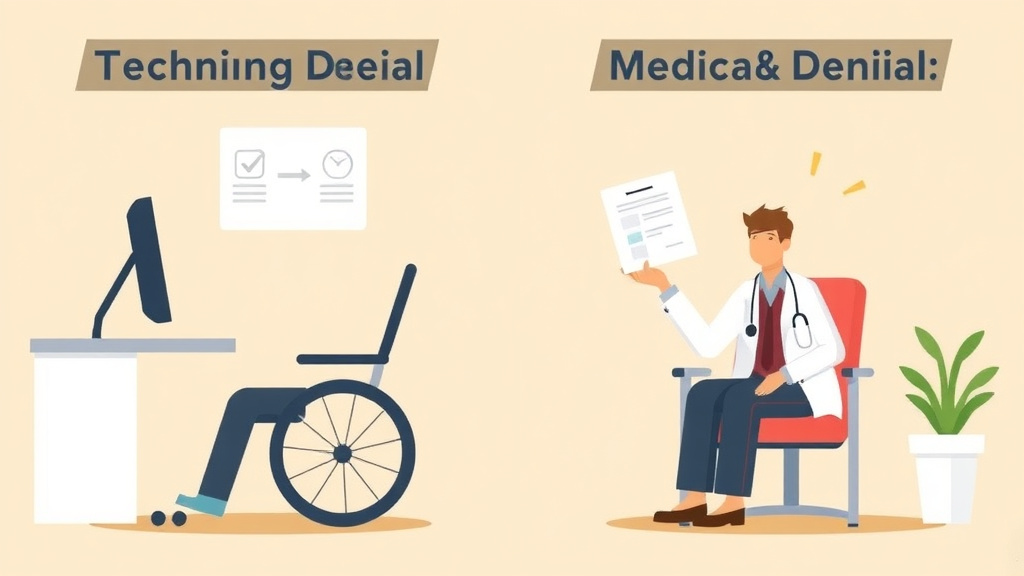
Not all denials are the same. How the SSA denied you determines what you should do next. A technical denial and a medical denial require completely different responses.
Request your medical records directly from each provider rather than relying on SSA to gather them. SSA requests can take months, and records sometimes get lost in the process. Include records from every provider you have seen for your disabling conditions, even if a visit seemed minor. Gaps in treatment history are one of the most common reasons for denial. Medical records from the past 12 months carry the most weight, but older records help establish the onset date. A treatment history spanning several years shows the condition is persistent, not temporary.
Technical Denials
A technical denial means the SSA stopped your claim before any medical review. Your condition was never evaluated. Common reasons:
| Reason | What It Means | What to Do |
|---|---|---|
| Insufficient work credits | You don't meet SSDI's work history requirement | Apply for SSI instead (no work credits needed) |
| Earning above SGA | Your current earnings exceed $1,620/month | Wait until earnings drop below SGA, then file |
| Failure to cooperate | You didn't return forms or attend a CE | Request reconsideration and comply this time |
| Can't be located | The SSA couldn't contact you | Update your address and reapply |
| Past DLI with no evidence of disability before DLI | Your insured status expired | Provide evidence your condition began before your DLI |
About 20% of all SSDI denials are technical. These are entirely preventable with proper application preparation.
A denial does not mean your case is over. About 2 out of 3 initial SSDI applications are denied, and many of those denials are overturned on appeal. Read your denial letter carefully. It tells you exactly why SSA denied your claim. The most common reasons are insufficient medical evidence and SSA determining you can still perform some type of work. You have 60 days from the date on your denial letter to file an appeal. Missing this deadline means starting over from scratch, so mark it on your calendar immediately.
Medical Denials
A medical denial means the SSA reviewed your medical evidence and concluded you don't meet their definition of disability. The denial letter will typically give one of these reasons:
- "Your condition is not severe enough." The SSA found your condition doesn't cause more than minimal limitations (denied at Step 2).
- "You can still do your past work." Your RFC allows you to perform one or more of your past jobs (denied at Step 4).
- "You can do other work." Even though you can't do past work, the SSA found other jobs you could perform (denied at Step 5).
- "Your condition will improve within 12 months." The SSA doesn't believe your condition meets the duration requirement.
Medical Denial Appeal Strategy
Medical denials are where most appeal efforts should focus. The reconsideration approval rate is only about 13%, but the ALJ hearing approval rate jumps to 45-55%. At hearing, you can present new evidence, have witnesses testify, and your case is reviewed fresh by a judge rather than a DDS examiner.
How to Tell Which You Got
Your denial letter (Notice of Disapproved Claim) contains specific language that identifies the type:
- Technical: Look for phrases like "not insured for disability benefits," "earnings above the limit," or "did not provide requested information."
- Medical: Look for phrases like "your condition does not prevent you from working," "you are able to do other work," or "your condition is expected to improve."
SSA evaluates disability claims using the Blue Book, which lists qualifying conditions and the specific criteria each must meet. If your condition matches a Blue Book listing, approval is more straightforward. Even if your condition does not match a Blue Book listing exactly, you can still qualify through a medical-vocational allowance. This considers your age, education, work experience, and functional limitations together. Consistent treatment records are critical. SSA looks for ongoing documentation showing your condition limits your ability to work, not just a single diagnosis.
Your Next Steps
After a Technical Denial
- Identify the exact technical reason
- Determine if it's correctable (can you get below SGA? were forms lost in the mail?)
- If it's a work credit issue, file for SSI immediately
- If it's a cooperation issue, request reconsideration and comply fully
- Check your DLI if you've been out of work for several years
After a Medical Denial
- File your appeal (reconsideration) within 60 days
- Get new and updated medical records
- Ask your treating physician for a detailed opinion on your functional limitations
- Address the specific reason for denial in your appeal
- Consider whether any evidence gaps can be filled
DisabilityFiled offers a $49 Complete Packet that organizes your information for your own application. It is a document preparation service, not a law firm, and it does not provide legal advice or guarantee any outcome.DisabilityFiled offers a $49 Complete Packet that organizes your information for your own application. It is a document preparation service, not a law firm, and it does not provide legal advice or guarantee any outcome.
Start your application with DisabilityFiled
Related Articles
- SSDI Denial Rates
- How to Read Your Denial Letter
- Work Credits Explained
- Medical Evidence Requirements
SSA evaluates disability claims using the Blue Book, which lists qualifying conditions and the specific criteria each must meet. If your condition matches a Blue Book listing, approval is more straightforward. Even if your condition does not match a Blue Book listing exactly, you can still qualify through a medical-vocational allowance. This considers your age, education, work experience, and functional limitations together. Consistent treatment records are critical. SSA looks for ongoing documentation showing your condition limits your ability to work, not just a single diagnosis.
What to Do Next
- Check the date on your denial letter and mark your 60-day appeal deadline on a calendar. Missing this window means restarting the entire process.
- Request a complete copy of your SSA file (called the 'exhibit file') so you can see exactly what evidence the reviewer had, and identify any gaps you need to fill.
- Get an updated RFC form from your treating doctor that addresses the specific reasons listed in your denial. If SSA said you can do sedentary work, your doctor needs to explain why you cannot.
Try our free tools
Frequently Asked Questions
How do they compare in terms of technical denial vs medical denial: which did you get??
A technical denial means the SSA rejected your claim without reviewing your medical evidence, usually because you lack work credits, earn above SGA, or failed to cooperate with requests. A medical denial means they reviewed your evidence and decided you're not disabled under their standards. Technical denials may mean you should apply for SSI instead.
How does a technical denial differ from a medical denial?
A technical denial means the SSA stopped your claim before any medical review, while a medical denial means the SSA reviewed your medical evidence and concluded you don't meet their definition of disability.
Why might the SSA issue a medical denial?
The denial letter will typically give one of these reasons: your condition is not severe enough, your condition is not expected to last 12 months, or your condition does not prevent you from working.
How to Tell Which You Got?
Your denial letter (Notice of Disapproved Claim) contains specific language that identifies the type: