SSI Payment Amount 2026: Federal Rate and State Supplements
TL;DR: The 2026 federal SSI rate is $967/month for individuals and $1,450/month for couples. Many states add supplements: California adds $197, New York adds $87. Your actual payment depends on income (earned and unearned), living arrangements (reduced by 1/3 if someone else pays your shelter), and state. The SSA applies a $20 general income disregard and a $65-plus-half disregard for earned income. About a dozen states pay no supplement.
SSI payments are not based on your earnings history like SSDI. Everyone starts at the same federal rate, then adjustments are made for your specific situation.
Approval rates at the ALJ hearing level are significantly higher than at the initial or reconsideration stages. Nationally, about 50% of claimants who reach a hearing receive a favorable decision. Claimants with legal representation at hearings win approval at roughly twice the rate of those without representation. Many disability attorneys work on contingency, so there is no upfront cost. Your specific approval odds depend on your medical evidence, your age, your work history, and the particular judge assigned to your case.
2026 Federal Rates
| Category | Monthly Amount |
|---|---|
| Individual | $967 |
| Couple (both eligible) | $1,450 |
| Essential person | $484 |
Approval rates at the ALJ hearing level are significantly higher than at the initial or reconsideration stages. Nationally, about 50% of claimants who reach a hearing receive a favorable decision. Claimants with legal representation at hearings win approval at roughly twice the rate of those without representation. Many disability attorneys work on contingency, so there is no upfront cost. Your specific approval odds depend on your medical evidence, your age, your work history, and the particular judge assigned to your case.
How Income Reduces Your Payment
The SSA counts income against your SSI payment with these disregards:
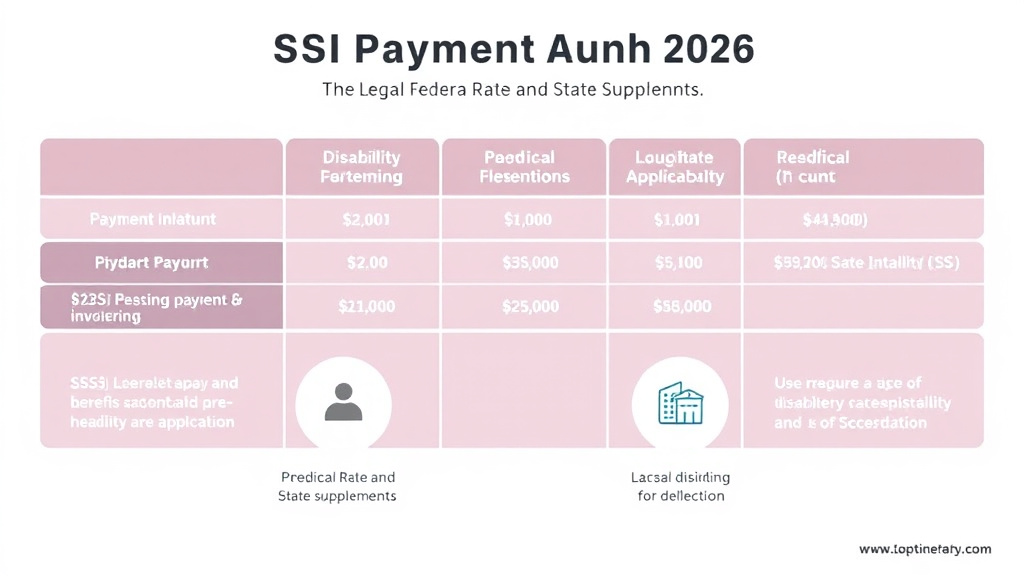
- $20 general disregard: Applied first to unearned income
- $65 earned income disregard: Plus 50% of remaining earnings ignored
- Dollar-for-dollar reduction: After disregards, each dollar reduces SSI by a dollar
Example
If you have $200/month in unearned income and $400/month in earned income:
- Unearned: $200 - $20 disregard = $180 countable
- Earned: $400 - $65 disregard = $335, then half = $167.50 countable
- Total countable: $347.50
- SSI payment: $967 - $347.50 = $619.50/month
Most disability attorneys charge a contingency fee of 25% of your backpay, capped at $7,200. You pay nothing upfront and nothing if you lose.DisabilityFiled offers a $49 Complete Packet that organizes your information for your own application. It is a document preparation service, not a law firm, and it does not provide legal advice or guarantee any outcome. This means you keep 100% of your benefits regardless of how large your backpay award is. Compare total costs before choosing representation.DisabilityFiled offers a $49 Complete Packet that organizes your information for your own application. It is a document preparation service, not a law firm, and it does not provide legal advice or guarantee any outcome.
Living Arrangement Reductions
If someone else pays for your food or shelter, the SSA may apply the "in-kind support and maintenance" rule, reducing your payment by up to one-third of the federal rate. This brings the maximum down to about $644/month.
The SSDI application process takes an average of 3 to 6 months for an initial decision. If denied, the appeals process can add another 12 to 24 months depending on your region. Having complete and detailed medical documentation is the single biggest factor in SSDI approval. Request records from all treating providers before submitting your application. Many claimants benefit from organizing their medical history into a timeline showing how their condition has progressed. This helps SSA reviewers see the full picture without searching through hundreds of pages.
State Supplements
States that add supplemental payments include California, New York, Massachusetts, Connecticut, New Jersey, and about 30 others. States that do not supplement include Texas, Georgia, Mississippi, and several other southern states.
Start your application with DisabilityFiled
Related Articles
The SSDI application process takes an average of 3 to 6 months for an initial decision. If denied, the appeals process can add another 12 to 24 months depending on your region. Having complete and detailed medical documentation is the single biggest factor in SSDI approval. Request records from all treating providers before submitting your application. Many claimants benefit from organizing their medical history into a timeline showing how their condition has progressed. This helps SSA reviewers see the full picture without searching through hundreds of pages.
What to Do Next
- Log into your my Social Security account to verify your current benefit amount and payment schedule.
- Contact your local SSA office to ask how any other benefits you receive interact with your SSDI payment. Get the answer in writing if possible.
- Review your most recent SSA award letter for any conditions or reporting requirements attached to your benefits.
- Set up direct deposit if you have not already. SSA strongly recommends electronic payments, and they arrive faster than paper checks.
Understanding the Details
Understanding how different benefits interact with SSDI prevents surprises that can affect your financial stability. Some programs reduce your SSDI payment through offsets, while others have no effect on your disability benefits. Workers' compensation is the most common program that triggers an offset. SSA calculates the combined amount of your SSDI and workers' comp, and if it exceeds 80% of your pre-disability earnings, SSA reduces your SSDI payment to bring the total under that threshold.
Medicare coverage begins 24 months after your SSDI entitlement date, not 24 months after you receive your first payment. Many claimants are confused by this timeline. During the waiting period, you may qualify for Medicaid through your state, or you can purchase coverage through the Health Insurance Marketplace. Some states have expanded Medicaid programs that cover individuals during the SSDI waiting period.
SSI (Supplemental Security Income) has stricter rules about other income and resources than SSDI does. SSI recipients cannot have more than $2,000 in countable resources ($3,000 for a couple). Lump-sum payments from other programs, retroactive benefits, or settlements can push you over this limit. If you receive a lump sum, you may need to spend it down within a specific timeframe or set up a special needs trust to protect your SSI eligibility.
Try our free tools
Frequently Asked Questions
How much is the SSI payment amount in 2026?
The 2026 federal SSI rate is $967/month for individuals and $1,450/month for couples. Many states add supplements, such as California adding $197 and New York adding $87.
How Income Reduces Your Payment?
States that add supplemental payments include California, New York, Massachusetts, Connecticut, New Jersey, and about 30 others. States that do not supplement include Texas, Georgia, Mississippi, and others.
Can my SSI payment be reduced if someone else pays for my food or shelter?
Yes, if someone else pays for your food or shelter, the SSA may apply the 'in-kind support and maintenance' rule, reducing your payment by up to one-third of the federal rate, down to about $644/month.
Which states provide supplemental SSI payments?
States that add supplemental payments include California, New York, Massachusetts, Connecticut, New Jersey, and about 30 others. States that do not supplement include Texas, Georgia, Mississippi, and several other southern states.