What Counts as a Disability? The SSA's Definition Explained
TL;DR: The SSA defines disability as the inability to perform substantial gainful activity (earning $1,620+/month in 2026) due to a medical condition lasting 12+ months or expected to result in death. It's not about having a diagnosis. It's about proving your condition prevents you from doing any work that exists in the national economy. The SSA uses a five-step evaluation process where most claims are decided at Steps 3, 4, or 5.
The SSA's definition of disability is one of the strictest in any government program. It's not the same as being unable to do your current job. It's not the same as a VA disability rating. And it's definitely not the same as your doctor saying you're disabled.
Understanding exactly what the SSA means by "disabled" is the first step toward building an application that actually gets approved.
The Legal Definition
Under the Social Security Act, you're disabled if:
- You cannot engage in substantial gainful activity (SGA)
- Because of a medically determinable physical or mental impairment
- That has lasted or is expected to last for at least 12 continuous months
- Or is expected to result in death
Every word in that definition matters, and the SSA interprets each one precisely.
Substantial Gainful Activity
In 2026, SGA means earning $1,620 or more per month (or $2,700 if you're blind). If you're currently earning above that threshold, the SSA won't even look at your medical records. You're not "disabled" in their eyes if you can earn that much.
Medically Determinable Impairment
This means your condition must be established through acceptable medical evidence: clinical signs, laboratory findings, imaging, or other diagnostic tests. Symptoms alone, no matter how severe, aren't enough. You need a documented diagnosis backed by objective medical data.
12-Month Duration
Your condition must have lasted, or be expected to last, at least 12 months. A severe but temporary condition, like a complicated fracture that will fully heal in 6 months, doesn't qualify. The clock starts at the onset of disability, not the date of diagnosis.
The Five-Step Sequential Evaluation
The SSA evaluates every claim using this exact process, in this exact order:
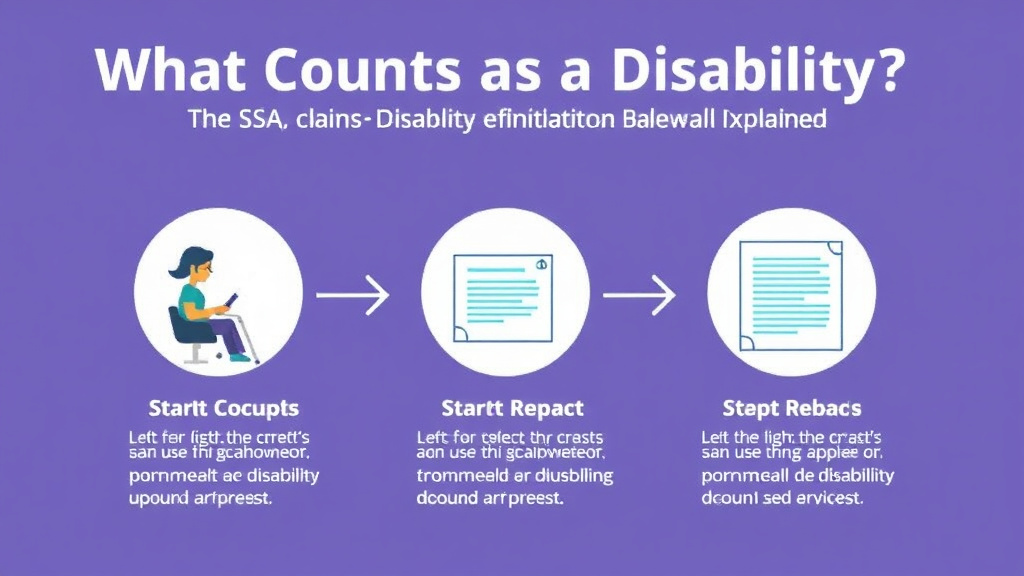
Step 1: Are You Working at SGA Level?
If yes, claim denied. This is a bright-line rule with limited exceptions.
Step 2: Is Your Impairment Severe?
Your condition must cause more than a "minimal" limitation on your ability to perform basic work activities. Basic work activities include physical functions (walking, standing, lifting), mental functions (understanding, remembering, concentrating), and sensory functions (seeing, hearing).
The severity threshold is relatively low. Most legitimate conditions pass Step 2.
Step 3: Does Your Condition Meet or Equal a Listing?
The SSA maintains the "Blue Book" (Listing of Impairments) with specific severity criteria for hundreds of conditions organized by body system. If your condition meets every criterion of a listing, you're approved at Step 3 without further analysis.
You can also qualify at Step 3 if your condition is "medically equivalent" to a listing, meaning it's at least as severe even though it doesn't match the exact criteria.
Step 4: Can You Do Your Past Relevant Work?
If you don't meet a listing, the SSA determines your Residual Functional Capacity (RFC). Your RFC defines what you can still do physically and mentally despite your limitations. The SSA then compares your RFC to the demands of jobs you held in the last 15 years.
If your RFC allows you to perform any of your past jobs as they're generally performed in the national economy, you're denied.
Step 5: Can You Do Any Other Work?
This is the final step and where age, education, and work experience come into play. The SSA uses the Medical-Vocational Guidelines (grid rules) along with your RFC to determine whether there are jobs in the national economy you could perform.
The grid rules significantly favor older applicants. A 55-year-old with a high school education and a physical work background who's limited to sedentary work will likely be found disabled. A 30-year-old with a college degree in the same situation probably won't.
What "Any Work" Actually Means
At Step 5, the SSA isn't asking whether there are jobs available in your area or whether anyone would actually hire you. They're asking whether jobs exist in significant numbers in the national economy that someone with your limitations, age, education, and experience could theoretically perform.
This is an intentionally broad standard. The SSA may find that you can work as a "document preparer" or "addresser" or "surveillance system monitor" even if you've never heard of these jobs and there are only a few thousand of them nationwide.
Conditions That Qualify vs Conditions That Don't
There's no simple list of "qualifying conditions." The SSA evaluates the severity and functional impact of your specific situation. Two people with the same diagnosis can have completely different outcomes.
It's About Function, Not Diagnosis
A diagnosis of degenerative disc disease means nothing by itself. What matters is: Can you sit for 6 hours? Can you lift 10 pounds? Can you bend, stoop, or crouch? Can you concentrate for 2-hour periods? These functional limitations are what drive the decision.
| Diagnosis | Might Qualify If | Probably Won't Qualify If |
|---|---|---|
| Major depression | Documented inability to concentrate, persistent episodes, multiple hospitalizations | Mild symptoms controlled with medication, no functional limitations documented |
| Back pain (DDD) | Nerve root compression on MRI, failed surgery, can't sit/stand more than 30 min | Normal imaging, no treatment beyond OTC meds, working full-time |
| Diabetes | Neuropathy, retinopathy, kidney damage despite compliance | Well-controlled with medication, no complications |
| COPD | FEV1 values meeting listing criteria, supplemental oxygen required | Mild airflow limitation, can walk without difficulty |
| Anxiety disorder | Panic attacks 3x/week, can't leave house, documented by psychiatrist | Situational anxiety, no treatment history |
Combined Impairments
You don't need one catastrophic condition. The SSA must consider the combined effect of all your impairments, including those that aren't "severe" individually. A person with moderate arthritis, moderate depression, chronic fatigue, and mild COPD might qualify based on the cumulative impact even though no single condition meets a listing.
This is actually how most claims are approved: not by meeting a listing, but by showing that the combination of conditions limits RFC to a point where no jobs are available given the applicant's age, education, and experience.
What Doesn't Count
- Partial disability. The SSA doesn't do partial. You're either unable to work at SGA level or you're not.
- Your doctor's opinion alone. A letter saying "my patient is disabled" carries some weight but is not determinative. The SSA makes its own assessment.
- VA disability ratings. A 100% VA rating doesn't guarantee SSDI approval. Different agencies use different standards.
- Inability to find work. Being unable to find a job because of your condition, age, or job market is not the same as being unable to work.
- Pain without objective findings. The SSA considers pain, but only when supported by medical evidence of a condition that could reasonably cause it.
Making Your Condition Count
The gap between being disabled and being found disabled by the SSA is documentation. Every functional limitation needs medical evidence behind it. Every symptom needs a diagnosis. Every limitation needs to be described in terms the SSA uses.
DisabilityFiled offers a $49 Complete Packet that organizes your information for your own application. It is a document preparation service, not a law firm, and it does not provide legal advice or guarantee any outcome.DisabilityFiled offers a $49 Complete Packet that organizes your information for your own application. It is a document preparation service, not a law firm, and it does not provide legal advice or guarantee any outcome.
Start your application with DisabilityFiled
Related Articles
- The SSA's 5-Step Evaluation Process
- The SSA Blue Book Explained
- Residual Functional Capacity (RFC)
- Meeting a Listing vs RFC
- SSDI with Multiple Conditions
Try our free tools
Frequently Asked Questions
What Counts as a Disability? The SSA's Definition Explained?
The SSA defines disability as the inability to perform substantial gainful activity (earning $1,620+/month in 2026) due to a medical condition lasting 12+ months or expected to result in death. It's not about having a diagnosis. It's about proving your condition prevents you from doing any work that exists in the national economy.
How does the Social Security Administration define disability?
Under the Social Security Act, you're disabled if you have a physical or mental impairment that prevents you from working at a substantial gainful activity level and is expected to last at least 12 months or result in death.
What is the five-step sequential evaluation process used by the SSA?
The SSA evaluates every claim using a five-step process: 1) Are you working at a substantial gainful activity level? 2) Is your impairment severe? 3) Does your impairment meet or equal a listed impairment? 4) Can you do your past relevant work? 5) Can you do any other work?
What "Any Work" Actually Means?
At Step 5, the SSA isn't asking whether there are jobs available in your area or whether anyone would actually hire you. They're asking whether jobs exist in significant numbers in the national economy that someone with your limitations, age, education, and experience could theoretically perform.
How do they compare in terms of conditions that qualify vs conditions that don't?
There's no simple list of "qualifying conditions." The SSA evaluates the severity and functional impact of your specific situation. Two people with the same diagnosis can have completely different outcomes.
Can the SSA consider the combined effects of multiple impairments?
Yes, the SSA must consider the combined effect of all your impairments, including those that aren't 'severe' individually. A person with moderate conditions like arthritis, depression, and chronic fatigue may be found disabled even if none of those conditions are severe on their own.
Why is documentation important when applying for disability benefits?
The gap between being disabled and being found disabled by the SSA is documentation. Every functional limitation needs medical evidence behind it, and every symptom needs a diagnosis.