What Happens After SSDI Approval: Timeline and Next Steps
TL;DR: After approval, your first SSDI payment arrives in the month following the first payable month (6th month after onset). Backpay for prior months is typically paid as a lump sum within 60 days. Medicare starts 24 months after your entitlement date. You'll receive a benefit verification letter and Social Security card if needed. The SSA assigns a diary date for your future CDR. You can start using work incentives (Trial Work Period, Ticket to Work) at any time.

Processing times vary by office workload and case complexity. Cases with complete medical records typically move faster through the system. If your case has been pending longer than expected, contact the hearing office directly to check status. You can also ask your congressional representative's office to make an inquiry on your behalf. SSA processed over 2 million disability claims in 2024, and staffing shortages at regional offices contributed to longer wait times in many areas.
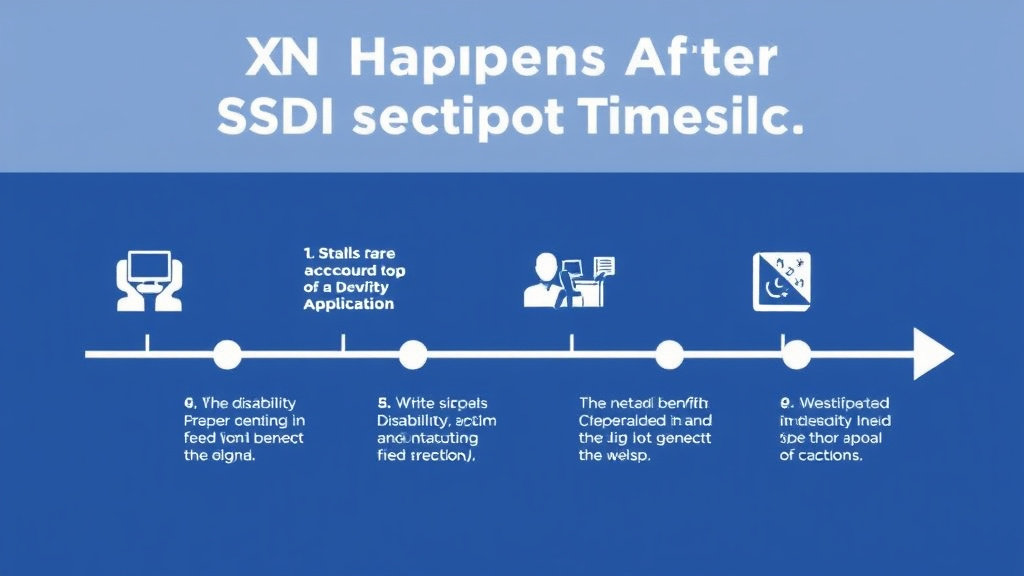
Post-Approval Timeline
| When | What Happens |
|---|---|
| Within 30 days of approval | Award letter arrives with benefit amount and onset date |
| Within 60 days | Backpay lump sum deposited (SSDI) or installments begin (SSI) |
| Monthly thereafter | Regular SSDI payment deposited (usually 2nd, 3rd, or 4th Wednesday based on birthday) |
| 24 months after entitlement | Medicare Part A and B begin |
| 3-7 years after approval | First Continuing Disability Review |
Processing times vary by office workload and case complexity. Cases with complete medical records typically move faster through the system. If your case has been pending longer than expected, contact the hearing office directly to check status. You can also ask your congressional representative's office to make an inquiry on your behalf. SSA processed over 2 million disability claims in 2024, and staffing shortages at regional offices contributed to longer wait times in many areas.
Things to Do After Approval
- Set up direct deposit if you haven't already
- Verify your benefit amount matches the award letter
- Continue all medical treatment (CDRs will check)
- Report any work activity to the SSA
- Explore health insurance options during the Medicare waiting period
- Consider a Ticket to Work if you want to test employment
There is more to post-approval timeline than surface-level advice. The details covered here apply to your specific situation. Here is what you need to know.
Related Articles
Approval rates at the ALJ hearing level are significantly higher than at the initial or reconsideration stages. Nationally, about 50% of claimants who reach a hearing receive a favorable decision. Claimants with legal representation at hearings win approval at roughly twice the rate of those without representation. Many disability attorneys work on contingency, so there is no upfront cost. Your specific approval odds depend on your medical evidence, your age, your work history, and the particular judge assigned to your case.
Key Facts About the SSDI Process
Consultative examinations (CEs) are medical exams that SSA pays for when your existing medical evidence is insufficient. A CE is typically brief, lasting 15 to 30 minutes. The examiner may not be a specialist in your condition. Because CEs are short and conducted by unfamiliar providers, they often understate your limitations. Strong records from your own treating doctors help counterbalance a weak CE report.
Online applications through ssa.gov are the fastest way to file for SSDI. You can save your progress and return later. The online application collects basic information about your work history, medical conditions, and treating providers. After you submit, SSA sends your case to your state's Disability Determination Services for review. You can check the status of your application online through your my Social Security account.
The five-month waiting period is one of the most misunderstood parts of SSDI. No benefits are payable for the first five full calendar months after your established onset date. This is a statutory requirement that applies to all SSDI claimants. The waiting period cannot be waived, shortened, or appealed.
What to Do Next
- Create a my Social Security account at ssa.gov if you do not have one yet. This gives you access to your earnings record, benefit estimates, and the ability to report changes online.
- Collect and organize all medical records related to your disabling conditions. Missing records are the most common reason for delays and denials.
- Write a detailed description of your daily routine, focusing on what you cannot do or what takes significantly longer than it used to. SSA uses this information to assess your functional capacity.
- DisabilityFiled offers a $49 Complete Packet that organizes your information for your own application. It is a document preparation service, not a law firm, and it does not provide legal advice or guarantee any outcome.com/start. Complete, SSA-compliant paperwork significantly increases your chances of approval.
Understanding the Details
Many claimants underestimate the importance of the function report (SSA Form 3373). This form asks you to describe your daily activities, social interactions, and physical/mental abilities in your own words. Be honest and specific. Instead of writing 'I can't do much,' describe exactly what you struggle with: 'I can wash dishes for about 5 minutes before my hands go numb and I have to stop. Loading the dishwasher requires bending, which causes sharp pain in my lower back.'
The SSDI application process evaluates whether your medical condition prevents you from performing any type of work that exists in the national economy. SSA uses a five-step sequential evaluation process. First, they check whether you are currently working above the SGA limit. Then they assess whether your condition is severe. Next, they compare your condition to the Blue Book listings. If you do not meet a listing, they evaluate your residual functional capacity and determine whether you can do your past work or any other work.
Medical evidence is the foundation of every SSDI claim. SSA requires evidence from acceptable medical sources, which include licensed physicians, psychologists, optometrists, podiatrists, and qualified speech-language pathologists. Treatment notes, imaging results, lab work, and psychological testing all contribute to the evidence file. The more detailed and specific your medical records are, the easier it is for SSA to evaluate your claim.
The SSDI waiting period is 5 full calendar months from your established onset date. This means your first SSDI payment covers the sixth full month of disability. For example, if SSA determines your onset date is January 15, your first payable month is July, and you would receive your first payment in August. Backpay covers the months between your first payable month and the month your claim was approved.
Try our free tools