Last updated 2026-07-09
TL;DR
Social Security doesn't use a percentage scale for hearing loss. It uses decibel (dB) thresholds from audiometric testing. The standard cutoffs are an average of 90 dB or worse in your better ear, or a word recognition score of 40% or less. Miss both and your claim isn't over. A residual functional capacity analysis can still get you approved.
Why doesn't SSA use a percentage to measure hearing loss?
SSA doesn't rate hearing loss by percentage. It uses decibel readings and word recognition scores from a formal audiogram. If you've seen a "60% hearing loss" figure somewhere, that number does nothing for a Social Security claim by itself.
Most people asking this question have seen percentages on a workers' comp form or a VA rating sheet and assume Social Security runs the same math. It doesn't. Nothing in the SSA rules converts your hearing into a single percentage that unlocks approval.
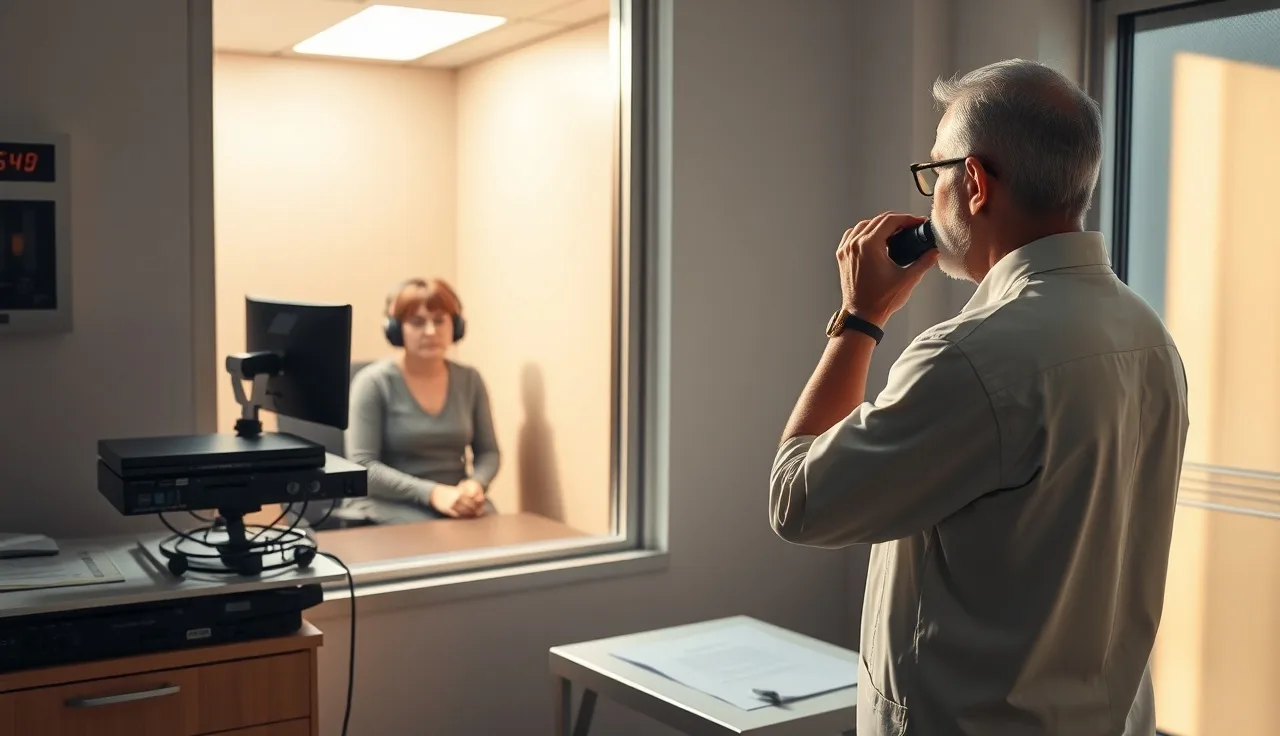
SSA rates hearing loss through audiometric results measured in a sound booth by an audiologist: pure-tone averages and word recognition scores. Blue Book Listing 2.10 (hearing loss not treated with cochlear implants) and Listing 2.11 (hearing loss treated with cochlear implants) describe the criteria in decibels and speech discrimination percentages, not in the informal ratings you may have heard from another agency [1].
The VA, for example, uses a conversion table that turns pure-tone averages and speech discrimination into a 0% to 100% rating. SSA has no such table. What matters to Social Security is the raw audiometric data behind any percentage a doctor gave you.
This has real consequences. Someone with a "moderate" loss that a non-SSA chart labels 35 to 50% can still meet SSA's listing if the pure-tone average in the better ear hits 90 dB. And someone rated 70% disabled under another system might miss SSA's rules entirely if their better ear still works above the threshold.
What are the exact decibel and word recognition thresholds SSA requires?
Listing 2.10 gives you two ways to qualify, and you only need to meet one. The first is a pure-tone average of 90 dB or greater in your better ear. The second is a word recognition score of 40% or less in your better ear. Both are measured unaided [1].
The pure-tone average (PTA) is the average of your hearing thresholds at 500 Hz, 1000 Hz, 2000 Hz, and 3000 Hz, using air conduction testing with masking in the non-test ear.
The word recognition score (also called speech discrimination) uses a standardized recorded list like the NU-6 or CID W-22, played loud enough that you can physically hear it. SSA's POMS DI 24580.010 lays out the testing protocols and the rule that testing use a calibrated audiometer in a soundproofed room [2].
Here's why both paths exist. Plenty of people lose the ability to understand speech even when they can still tell that sound is present. A person might hear that someone is talking at 70 dB and catch almost none of the actual words. The word recognition path captures that gap.
| Listing Path | Threshold | Measured How |
|---|---|---|
| Pure-tone average (better ear) | 90 dB or greater | Air conduction, 500 to 3000 Hz average |
| Word recognition score (better ear) | 40% or less | Standardized recorded word list, better ear |
Listing 2.11 handles cochlear implants. Recipients are considered disabled automatically for 12 months after the implant surgery. Once that window closes, a word recognition score above 60% on the HINT or AzBio sentence test generally won't meet the listing, which pushes the case into a residual functional capacity analysis [1].
One detail many applicants miss: SSA wants testing no more than 60 days old at the time of the determination, performed by an audiologist or an otolaryngologist [2]. That audiogram your ENT ran five years ago probably won't cut it.
What if your hearing loss doesn't meet the listing numbers?
Missing a listing is not a denial. It moves your claim to the next step: a residual functional capacity (RFC) assessment that looks at what you can still do in a work setting given your age, education, and work history.
The RFC analysis asks whether your hearing loss keeps you from doing your past work, and if so, whether other jobs exist in significant numbers nationally that you could do. This is where the grid rules and vocational evidence enter the picture.
A lot of hearing loss claims are won here rather than at the listing level. Picture someone 58 years old, 20 years as a teacher, now with a bilateral moderate-to-severe loss averaging 75 dB in the better ear. They don't hit 90 dB. But their RFC might show they can't work where constant communication is required, can't hear alarms, and can't reliably use a standard telephone. A vocational expert could testify that this rules out most sedentary and light jobs open to someone with that background.
Age carries weight here. SSA's Medical-Vocational Guidelines (the "grids") treat claimants 50 and older more favorably. An older worker limited to jobs with minimal oral communication has a real edge over a 35-year-old with the identical audiogram [3].
So gather your audiological records, get a detailed RFC opinion from your treating audiologist or physician, and document every functional problem your hearing causes at work: missed coworker instructions, phone calls you can't manage, background noise in open offices, safety warnings you don't catch.
How does SSA actually test and verify your hearing loss?
SSA needs tests that hit its technical specs. more than any audiogram from any provider will do.
Pure-tone audiometry must use air conduction with proper masking of the non-test ear, which prevents crossover hearing from inflating your results. Bone conduction tests alone don't count. The frequencies tested have to include 500, 1000, 2000, and 3000 Hz, since those are the ones averaged for the PTA [2].
Word recognition testing must use a recorded standardized test, not a live-voice test where the examiner reads words aloud. Live-voice has too much variability. SSA requires recorded testing because research has documented that live-voice presentation inflates word recognition scores by a clinically meaningful margin [4].
If your records fall short, SSA sends you to a consultative examination (CE) with an audiologist it picks and pays for. The CE is free to you. That audiologist writes a report SSA uses to decide the case. One caution: CE examiners often spend far less time with you than your own provider does. If you have a regular audiologist who has tested you thoroughly over the years, get a detailed report from them rather than leaning on the CE alone.
SSA also flags that ototoxic medications, Meniere's disease, and acoustic neuroma can cause fluctuating loss. If your hearing swings day to day, try to get tested on a bad day, or line up multiple tests that document the full range.
Does hearing loss in only one ear qualify you?
Single-sided deafness usually isn't enough to meet Listing 2.10 by itself. The listing points to the "better ear," so SSA measures how much functional hearing you have left in your best-performing ear [1].
If your better ear has a PTA of 60 dB, you don't meet the 90 dB threshold even if the other ear is stone deaf. Total deafness in one ear with normal hearing in the other reads, to SSA, as a one-ear problem, and most sedentary and light work doesn't require hearing in both ears.
Still, single-sided deafness paired with other impairments can support a claim. If you also have tinnitus, vestibular problems, chronic pain, or a second diagnosis, SSA has to weigh the combined effect of everything. The RFC evaluation looks at your impairments as a whole, not one at a time [3].
Bottom line: if unilateral deafness is your only impairment, you're facing a steep climb. If you have other conditions on top of it, document all of them carefully.
How does SSA handle hearing loss combined with other impairments?
SSA runs a "combination of impairments" analysis through its five-step process. When no single condition meets a listing, SSA still has to decide whether the combined severity of all your conditions equals a listed impairment and limits your ability to work [3].
Hearing loss with vertigo or balance disorders (common in Meniere's disease) can be a strong pairing, because the balance problems limit mobility and raise fall risk on their own. Hearing loss plus severe tinnitus can wreck concentration in ways the audiogram numbers never show. Hearing loss plus a mental health condition can build a combined RFC that rules out even simple, routine jobs.
The POMS instruction at DI 24515.061 tells adjudicators to consider whether the "combined effect of all the claimant's impairments" equals the severity of a listing even when no single impairment does [2]. Make sure every diagnosis in your records shows up on your application.
If you're juggling several conditions and unsure how to organize the paperwork, a structured intake can help you pull it together before you file. DisabilityFiled's guided intake tool is built for that, helping you document hearing loss alongside your other impairments in the format SSA reviewers expect to see.
Can children qualify for disability benefits because of hearing loss?
Yes. SSI is open to children under 18 with disabilities, and hearing loss is a listed impairment in the Childhood Listings under Sections 102.10 and 102.11, the pediatric versions of adult Listings 2.10 and 2.11 [5].
The thresholds match the adult ones: a PTA of 90 dB or worse in the better ear, or a word recognition score of 40% or less in the better ear. Children with cochlear implants get the same 12-month automatic qualification.
Beyond the listing, a child can qualify through a functional equivalence analysis across six domains: acquiring and using information, attending and completing tasks, interacting and relating with others, moving about and manipulating objects, caring for yourself, and health and physical well-being [5]. Profound hearing loss often causes marked limitations in the "interacting and relating" domain, especially for children who are also language-delayed.
For childhood SSI, family finances matter too. The program is means-tested, so parental income is "deemed" to the child and can reduce or wipe out the benefit even when the medical criteria are met [6]. SSDI, by contrast, needs the parent or child to have enough work credits, which is why most childhood disability benefits run through SSI.
What records do you need to win a hearing loss disability claim?
The number one reason hearing loss claims get denied is medical evidence that's missing or doesn't qualify. Here's what you actually need.
First, a recent audiological evaluation (within 60 days of the determination) from a licensed audiologist or otolaryngologist, using a calibrated audiometer in a soundproofed booth. The report has to include pure-tone thresholds at each frequency, the calculated PTA for each ear, and the word recognition score with the specific test named [2].
Second, records from your treating physician or ENT covering the diagnosis, its cause if known, how long it's lasted, and any treatments you've tried. If you've used hearing aids, note whether they correct the problem adequately. SSA can weigh whether aids restore your ability to work.
Third, a written opinion from your treating audiologist or physician on your functional limits, ideally on a form that addresses specific work tasks: using a telephone, understanding speech in noise, hearing alarms and signals, communicating with supervisors.
Fourth, for Meniere's disease or another episodic condition, a symptom diary plus records showing the frequency, severity, and length of episodes.
Fifth, if you're building an RFC argument rather than a listing-level one, lay witness statements from family or former coworkers describing how your hearing loss affects daily function can carry real weight in front of an administrative law judge.
How long does a hearing loss disability claim take and what are the approval rates?
A hearing loss claim follows SSA's standard timeline, and it rarely moves fast. Initial claims run roughly three to six months, and recent staffing shortages have pushed the average past six months in some years [7].
About 67% of initial SSDI applications are denied [7]. If yours is, you file a Request for Reconsideration, which gets denied at an even higher rate, roughly 87 to 90% in most states. The real shot comes before an administrative law judge (ALJ), where approval rates have historically landed around 45 to 55% [7].
Hearing loss claims don't have separately published approval rates. Claims that ride purely on audiometric thresholds tend to be fairly binary: the numbers either meet the listing or they don't. The RFC-based claims lean heavily on the quality of your vocational evidence and the ALJ you draw.
The full stretch from application to ALJ decision can run two to three years if you have to appeal. Check your local wait times by calling SSA or using the hearing office wait time data SSA publishes at hearingofficeinfo.oha.ssa.gov [8].
For SSDI, remember the five-month waiting period after your established onset date. Even approved claimants don't see a check on day one. You can read more about how SSDI work credits and eligibility are calculated to confirm you qualify before you sink time into the medical side.
Does wearing a hearing aid affect your disability claim?
This is one of the most misunderstood parts of a hearing loss claim. SSA's Blue Book Listing 2.10 says the audiometric testing must be done "without the use of hearing amplification" [1]. That single rule changes how you should think about your audiogram.
Your hearing aid may make your everyday hearing far better than your unaided numbers suggest. But for meeting Listing 2.10, SSA tests you unaided. So if your unaided PTA is 92 dB while your aided hearing is 55 dB, you meet the listing on the unaided test, aids or no aids.
At the RFC stage, though, SSA can and does look at whether hearing aids adequately correct your hearing for work. If your provider documents that even with the best amplification you still can't understand speech in a normal workplace, that backs an RFC limiting you to jobs with minimal communication demands.
Can't afford hearing aids? Document that. Financial inability to get corrective equipment is relevant to the RFC analysis. SSA isn't supposed to assume your condition is fixed by a device you don't own or can't reach [2].
What happens at an SSA hearing for a hearing loss claim?
If your claim reaches the ALJ level, the hearing is usually held by video or phone. Ironic for someone with hearing loss, and worth flagging to the hearing office right away.
You can request an in-person hearing if the video or phone format is a genuine barrier. If a telephone hearing is functionally impossible for you without help, notify the hearing office in writing before the scheduled date and ask for either an in-person format or real-time captioning. SSA has to provide reasonable accommodations under the Rehabilitation Act [9].
At the hearing, the ALJ reviews the medical evidence, asks about your daily activities and limits, and questions a vocational expert about what jobs someone with your RFC could do. Your attorney or representative can cross-examine that expert and argue your limits rule out the jobs named.
In hearing loss claims that aren't meeting a listing, the vocational expert testimony often decides the case. The winning argument is usually that your hearing loss, alone or combined with other impairments, rules out all competitive employment, more than your old job.
An experienced representative matters at this stage. You can read about working with one in our piece on finding an SSDI lawyer.
Is there a fast-track option for severe hearing loss?
SSA's Compassionate Allowances (CAL) program speeds up decisions for conditions where approval is nearly certain [10]. As of the most recent SSA update, hearing loss as a standalone diagnosis is not on the CAL list.
But conditions that cause severe hearing loss as one symptom, like certain tumors of the auditory nerve or brainstem, may sit on the CAL list under the primary diagnosis. If an underlying condition on the list is driving your hearing loss, your claim can get flagged for fast-track processing regardless of the hearing angle.
See the current list at SSA's Compassionate Allowances page or at ssa.gov/compassionateallowances.
Without a CAL, there's no formal fast-track for hearing loss alone. The only real acceleration left is a Dire Need or Terminal Illness designation, and neither applies to a typical hearing loss case.
Frequently asked questions
Is 90 dB hearing loss the only way to qualify for SSDI with hearing problems?
No. You can also qualify with a word recognition score of 40% or less in the better ear, which measures speech understanding rather than sound detection. Beyond those two listing paths, you can still win through a residual functional capacity (RFC) analysis showing that your hearing loss, possibly combined with other impairments, prevents you from doing any work that exists in significant numbers nationally.
Does SSA count a percentage rating from the VA or workers' comp as proof of disability?
SSA must consider a VA disability rating as evidence, but it is not binding. A 70% VA hearing disability rating does not automatically mean you qualify for SSDI or SSI. SSA applies its own criteria: the audiometric thresholds in Blue Book Listing 2.10. That said, a high VA rating attached to strong audiological records can support your claim at the RFC and ALJ levels.
Can I get SSI for hearing loss if I don't have enough work credits for SSDI?
Yes. SSI has no work history requirement. If you meet SSA's medical criteria for hearing loss disability and your income and resources fall below SSI limits (roughly $2,000 in countable assets for an individual as of 2024, and income below the federal benefit rate), you can qualify for SSI. The medical standard is identical to SSDI; the difference is financial eligibility, not the audiogram threshold.
What if my hearing loss fluctuates from day to day, like with Meniere's disease?
SSA requires testing to capture your actual functional limitation. With fluctuating conditions, try to schedule testing during a worse period, get multiple audiograms to document the range, and ask your doctor to write a detailed letter describing the frequency and severity of episodes. SSA should evaluate the worst consistent state of your hearing, not an unusually good day captured in a single test.
Do hearing aids disqualify me from getting disability for hearing loss?
No. Blue Book Listing 2.10 requires testing without hearing amplification, so your unaided audiogram is what determines whether you meet the listing. At the RFC stage, SSA may consider how well aids correct your hearing for work purposes, but if you can't afford aids, don't use them, or they provide inadequate correction for workplace settings, document that clearly in your medical records.
How much will I get paid if approved for SSDI with hearing loss?
SSDI payments are based on your lifetime earnings record, not the severity of your disability. The average SSDI payment in 2024 was roughly $1,537 per month, per SSA's own data, but your amount could be higher or lower. SSI, which is need-based, has a federal maximum of $943 per month for an individual in 2024. Check the current SSDI payment schedule for timing details.
Can a child with profound hearing loss get SSI?
Yes. Children under 18 can qualify for SSI under Blue Book Childhood Listing 102.10, which uses the same audiometric thresholds as adult Listing 2.10. SSI eligibility for children also involves a means test using parental income and assets. Even if the medical criteria are clearly met, high parental income can reduce or eliminate the monthly benefit amount.
What is a word recognition score and how is it tested?
A word recognition score (also called speech discrimination score) measures how accurately you can identify single-syllable words when they are presented at a comfortably loud volume. It uses a standardized recorded test list such as the NU-6 or CID W-22. Results are expressed as a percentage of words correctly repeated. SSA requires a score of 40% or less in the better ear to meet Listing 2.10 on this path.
What if I already had a hearing test but it wasn't done in a soundproof booth?
SSA requires pure-tone audiometry in a soundproofed room using a calibrated audiometer. A test done without those conditions, for example a basic office screen, generally does not meet SSA's evidentiary standard. SSA will either request qualifying testing from your provider or schedule a consultative examination with an audiologist at no cost to you.
Does tinnitus alone qualify me for SSDI?
Tinnitus alone rarely qualifies. There is no standalone Blue Book listing for tinnitus. To succeed with a tinnitus-centered claim, you generally need documentation that the tinnitus causes severe functional limitations, such as inability to concentrate, chronic sleep disruption, or a co-occurring anxiety disorder triggered by the sound. Tinnitus is usually evaluated as part of a combined-impairment RFC argument rather than on its own.
Can I work part-time while waiting for a hearing loss disability decision?
You can work as long as your earnings stay below SSA's Substantial Gainful Activity (SGA) threshold, which is $1,550 per month in 2024 for non-blind individuals. Earning above SGA will generally cause SSA to find you not disabled at step one of the evaluation. Part-time work below SGA is allowed and does not automatically disqualify you, though it can affect how SSA views your functional limitations.
How do I request accommodations for a telephone or video SSA hearing when I have hearing loss?
Contact the hearing office in writing as soon as you receive your hearing notice. State clearly that your hearing impairment makes the scheduled format inaccessible and request either an in-person hearing or real-time captioning. SSA is required to provide reasonable accommodations under the Rehabilitation Act. Do this well in advance; last-minute requests can delay your hearing rather than change its format.
What is the difference between an initial claim denial and needing to appeal?
An initial denial means SSA reviewed your application and found you did not meet the disability criteria. You have 60 days plus 5 days for mailing to file a Request for Reconsideration. If reconsideration is denied, you have the same window to request an ALJ hearing. Each level requires a new filing; missing the deadline generally means starting over from scratch with a new application. See our guide on what counts as a disability under SSA for more on the evaluation process.
Sources
- SSA, Blue Book Disability Evaluation Under Social Security, Listing 2.10 and 2.11 (Special Senses and Speech): Listing 2.10 requires a pure-tone average of 90 dB or greater in the better ear, or a word recognition score of 40% or less in the better ear, tested without hearing amplification. Listing 2.11 covers cochlear implant recipients.
- SSA, Program Operations Manual System (POMS), DI 24580.010, Evaluation of Hearing Loss: Testing must use a calibrated audiometer in a soundproofed room; word recognition testing must use a standardized recorded list; testing must be performed by an audiologist or otolaryngologist and be no more than 60 days old.
- SSA, Disability Planner, How We Decide If You Are Disabled (Five-Step Sequential Evaluation): SSA uses a five-step process; claimants who don't meet a listing are evaluated through residual functional capacity and medical-vocational guidelines, with age 50 and older treated more favorably under the grid rules.
- American Journal of Audiology (ASHA journals), studies on live-voice versus recorded word recognition testing: Live-voice word recognition presentation inflates scores compared to standardized recorded tests by a clinically meaningful margin, which is why SSA requires recorded testing.
- SSA, Blue Book, Childhood Listings 102.10 and 102.11 (Hearing Loss, Children): Childhood hearing loss listings under 102.10 and 102.11 use the same 90 dB PTA and 40% word recognition thresholds as adult listings; children with cochlear implants have a 12-month automatic qualification period.
- SSA, Understanding Supplemental Security Income, SSI for Children: For childhood SSI, parental income and resources are deemed to the child and can reduce or eliminate the benefit even if medical criteria are met; the SSI resource limit for an individual is approximately $2,000.
- SSA, Annual Statistical Report on the Social Security Disability Insurance Program, 2023: Approximately 67% of initial SSDI applications are denied; reconsideration denial rates approach 87 to 90% in most states; ALJ-level approval rates have historically been around 45 to 55%.
- SSA, Office of Hearings Operations, Hearing Office Wait Times: SSA publishes hearing office wait time data; the full process from application to ALJ decision can take two to three years when appeals are required.
- SSA, Accessibility and Reasonable Accommodations (Rehabilitation Act obligations): SSA is required to provide reasonable accommodations at administrative hearings under the Rehabilitation Act, including alternatives to telephone or video formats for claimants with hearing loss.
- SSA, Compassionate Allowances, Conditions List: SSA's Compassionate Allowances program accelerates decisions for conditions where approval is nearly certain; as of the most recent update, standalone hearing loss is not on the CAL list.
- SSA, 2024 SSI and SSDI Benefit Amounts and SGA Thresholds: The 2024 SGA threshold for non-blind individuals is $1,550 per month; average SSDI payment in 2024 was approximately $1,537 per month; maximum federal SSI benefit for an individual in 2024 is $943 per month.